Kerala
|
|---|
| State |

A Kerala houseboat near Alappuzha |
|
|
| Nickname(s): God's Own Country |
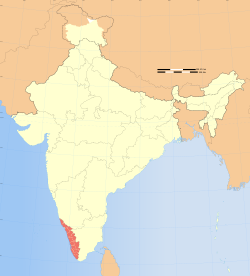
Location of Kerala in India |

Map of Kerala |
Coordinates (Trivandrum):  8.5074°N 76.973°ECoordinates: 8.5074°N 76.973°E |
| Country |
India |
| Region |
South India |
| Established |
1 November 1956 |
| Capital |
Thiruvananthapuram |
| Other major cities |
Thrissur, Kochi, Kozhikode, and Kollam. |
| Districts |
14 |
| Government |
| • Body |
Government of Kerala |
| • Governor |
Sheila Dikshit[1] |
| • Chief Minister |
Oommen Chandy (INC) |
| • Legislature |
Unicameral (141* seats) |
| • Parliamentary constituency |
20 |
| • High Court |
Kerala High Court |
| Area |
| • Total |
38,863 km2 (15,005 sq mi) |
| Area rank |
21st |
| Population (2011)[2] |
| • Total |
33,387,677 |
| • Rank |
12th |
| • Density |
860/km2 (2,200/sq mi) |
| Demonym |
Keralite, Malayali |
| Time zone |
IST (UTC+05:30) |
| ISO 3166 code |
IN-KL |
| HDI |
 0.790[3] (high) |
| HDI rank |
1st (2011) |
| Literacy |
95.5% |
| Official languages |
Malayalam, English |
| Website |
kerala.gov.in |
| ^* 140 elected, 1 nominated |
Kerala //, regionally referred to as
Keralam, is a
state in the
south-west region of
India on the
Malabar coast. It was formed on 1 November 1956 as per the
States Reorganisation Act by combining various
Malayalam-speaking regions. Spread over 38,863 km
2 (15,005 sq mi) it is bordered by
Karnataka to the north and north east,
Tamil Nadu to the east and south, and the
Lakshadweep Sea to the west. With 33,387,677 inhabitants as per the 2011 census, Kerala is
the twelfth largest state by population and is divided into 14
districts.
Malayalam is the most widely spoken and official language of the state. The state capital is
Thiruvananthapuram,other major cities include
Thrissur,
Kochi,
Kozhikode,and
Kollam.
The region was a prominent spice exporter from 3000 BCE to 3rd century. The
Chera Dynasty was the first powerful kingdom based in Kerala, though it frequently struggled against attacks from the neighbouring
Cholas and
Pandyas.
During the Chera period Kerala remained an international spice trading
center. Later, in the 15th century, the lucrative spice trade attracted
Portuguese traders to Kerala, and eventually paved the way for the
European colonisation of the whole of India. After independence,
Travancore and
Cochin joined the Republic of India and
Travancore-Cochin was given the status of a state. Later, the state was formed in 1956 by merging the
Malabar district, Travancore-Cochin (excluding four southern
taluks), and the taluk of
Kasargod,
South Kanara.
Kerala is the state with the lowest positive population growth rate in India (3.44%) and has a density of 819 people per km
2. The state has the highest
Human Development Index (HDI) (0.790) in the country according to the
Human Development Report 2011.
[3] It also has the highest
literacy rate 95.5, the highest
life expectancy (Almost 77 years) and the highest
sex ratio
(as defined by number of women per 1000 men: 1,084 women per 1000 men)
among all Indian states. Kerala has the lowest homicide rate among
Indian states, for 2011 it was 1.1 per 100,000.
[4] A survey in 2005 by
Transparency International
ranked it as the least corrupt state in the country. Kerala has
witnessed significant emigration of its people, especially to the
Gulf states during the
Gulf Boom during the 1970s and early 1980s, and its economy depends significantly on
remittances from a large
Malayali expatriate community.
Hinduism is practised by more than half of the population, followed by
Islam and
Christianity. The culture of the state traces its roots from 3rd century CE. It is a synthesis of
Aryan and
Dravidian cultures, developed over centuries under influences from other parts of India and abroad.
Production of pepper and natural rubber contributes to a significant
portion of the total national output. In the agricultural sector,
coconut, tea, coffee, cashew and spices are important. The state's
coastline extends for 590 kilometres (370 mi), and around 1.1 million
people of the state are dependent on the fishery industry which
contributes 3% of the state's income. The state's 145,704 kilometres
(90,536 mi) of roads, constitute 4.2% of all Indian roadways. There are
three existing and two proposed international airports. Waterways are
also used as a means of transportation. The state has the
highest media exposure in India
with newspapers publishing in nine different languages; mainly English
and Malayalam. Kerala is an important tourist destination, with
backwaters,
beaches,
Ayurvedic tourism, and
tropical greenery among its major attractions.
Kerala got selected as state of states in 2013 based on the criteria
of GDP Governance, health, education etc. Kerala’s 10% rise in GDP is 3%
more than the national GDP. Rise in capital expenditure is 30% against
national average of 5%. 35% rise in two-wheelers owners against national
average of 15%. Teacher pupil ratio jumped from 2:100 to 4:100.
[5]
Etymology
A 3rd-century BCE rock inscription by the
Mauryan emperor
Asoka the Great refers to the local ruler as
Keralaputra
(Sanskrit for "son of Kerala"; or "son of Chera[s]", this is
contradictory to a popular theory that etymology derives "kerala" from
"kera", or coconut tree in Malayalam).
[6]
Two thousand years ago, one of three states in the region was called
Cheralam in
Classical Tamil:
Chera and
Kera are variants of the same word.
[7] The Graeco-Roman trade map
Periplus Maris Erythraei refers to this Keralaputra as
Celobotra.
[8] Ralston Marr derives "Kerala" from the word "Cheral" that refers to the oldest known dynasty of Kerala kings.
[9]
In turn the word "Cheral" is derived from the proto-Tamil-Malayalam
word for "lake". Another theory suggests the name is derived from the
Arabic "Khair Allah"
Arabic:
خير الله.
[10]
Ancient religious texts

Parasurama, surrounded by settlers, commanding
Varuna to part the seas and reveal Kerala.
According to Hindu mythology, the land of Kerala was recovered from the sea by
Parasurama, an
avatar of
Vishnu; hence Kerala is also called
Parasurama Kshetram
("The Land of Parasurama"). Parasurama was an axe-wielding warrior
sage. He threw his axe across the sea, and the water receded as far as
it reached. According to legend this new area of land extended from
Gokarna to
Kanyakumari.
[11]
Consensus among more scientific geographers agrees that a substantial
portion of this area was indeed under the sea in ancient times.
[12] The legend later expanded, and found literary expression in the 17th or 18th century with
Keralolpathi,
which traces the origin of aspects of early Kerala society, such as
land tenure and administration, to the story of Parasurama.
[13]
In medieval times Kuttuvan might have emulated Parasurama tradition of
throwing his spear into the sea to symbolize his lordship of the sea.
[14] Another much earlier
Puranic character associated with Kerala is
Mahabali, an
Asura and a prototypical king of justice, who ruled the earth from Kerala. He won the war against the
Devas, driving them into exile. The Devas pleaded before Lord
Vishnu, who took his fifth incarnation as
Vamana and pushed Mahabali down to
Patala (the netherworld) to placate the Devas. There is a belief that, once a year during the
Onam festival, Mahabali returns to Kerala.
[15]
The
Matsya Purana, which is among the oldest of the 18
Puranas,
[16][17] makes the
Malaya Mountains of Kerala (and
Tamil Nadu) the setting for the story of Lord
Matsya, the first
incarnation of Lord
Vishnu, and King
Manu, the first man and the king of the region.
[18][19] The earliest Sanskrit text to mention Kerala by name is the
Aitareya Aranyaka of the
Rigveda.
[20] It is also mentioned in both the
Ramayana and the
Mahabharata, the two great Hindu epics.
[21]
History
Pre-history
Prehistorical archaeological findings include
dolmens of the
Neolithic era in the
Marayur area in Idukki district. They are locally known as "muniyara", derived from
muni (
hermit or
sage) and
ara (dolmen).
[22] Rock engravings in the
Edakkal Caves (in
Wayanad) are thought to date from the early to late Neolithic eras around 6000 BCE.
[23][24] Archaeological studies have identified many
Mesolithic, Neolithic and
Megalithic sites in Kerala.
[25] The studies point to the indigenous development of the ancient Kerala society and its culture beginning from the
Paleolithic age, and its continuity through Mesolithic,
Neolithic and Megalithic ages.
[26] However, foreign cultural contacts have assisted this cultural formation.
[27] The studies suggest possible relationship with
Indus Valley Civilization during the late
Bronze Age and early
Iron Age.
[28]
Ancient period
Kerala was a major spice exporter from as early as 3000 BCE, according to
Sumerian records.
[29] Its fame as the land of spices attracted ancient
Babylonians,
Assyrians and
Egyptians to the Malabar Coast in the 3rd and 2nd millennia BCE.
Arabs and
Phoenicians were also successful in establishing their prominence in the Kerala trade during this early period.
[30] The word
Kerala is first recorded (as
Keralaputra) in a 3rd-century BCE rock inscription (Rock Edict 2) left by the
Maurya emperor Asoka (274–237 BCE).
[31] The
Land of Keralaputra was one of the four independent kingdoms in southern India during Asoka's time, the others being
Chola,
Pandya, and
Satiyaputra.
[32] Scholars hold that Keralaputra is an alternate name of the
Cheras, the first powerful dynasty based on Kerala.
[33][34] These territories once shared a common language and culture, within an area known as
Tamiḻakam.
[35] While the Cheras ruled the major part of modern Kerala, its southern tip was in the kingdom of Pandyas,
[36] which had a trading port sometimes identified in ancient Western sources as
Nelcynda (or
Neacyndi).
[37] At later times the region fell under the control of the Pandyas, Cheras, and Cholas.
Ays and
Mushikas were two other remarkable dynasties of ancient Kerala, whose kingdoms lay to the south and north of Cheras respectively.
[38][39]
In the last centuries BCE the coast became famous among the Greeks and Romans for its spices, especially
black pepper. The Cheras had trading links with
China,
West Asia,
Egypt,
Greece, and the
Roman Empire. In the foreign-trade circles the region was identified by the name
Male or
Malabar.
[40] Muziris, Berkarai, and Nelcynda were among the principal ports at that time.
[41] The value of Rome's annual trade with India as a whole was estimated at no less than 50,000,000
sesterces;
[42] contemporary
Sangam literature describes Roman ships coming to
Muziris
in Kerala, laden with gold to exchange for pepper. One of the earliest
western traders to use the monsoon winds to reach Kerala may have been
Eudoxus of Cyzicus, around 118 or 166 BCE, under the patronage of
Ptolemy VIII, a king of the
Hellenistic Ptolemaic dynasty in Egypt. Various Roman establishments in the port cities of the region, such as a temple of
Augustus and barracks for garrisoned Roman soldiers, are marked in the
Tabula Peutingeriana: the only surviving map of the Roman
cursus publicus.
[43][44]
Merchants from West Asia and Southern Europe established coastal posts and settlements in Kerala.
[45] Jewish connection with Kerala started as early as 573 BCE.
[46][47] Arabs also had trade links with Kerala, possibly started before the 4th century BCE, as
Herodotus (484–413 BCE) noted that goods brought by Arabs from Kerala were sold to the Jews at Eden.
[41] They intermarried with local people, and from this mixture the large
Muslim Mappila community of Kerala are descended.
[48] In the 4th century, some Christians also immigrated from
Persia and joined the early
Syrian Christian community who trace their origins to the evangelistic activity of
Thomas the Apostle in the 1st century.
[49] Mappila
was an honorific title that had been assigned to respected visitors
from abroad; and Jewish, Syrian Christian, and Muslim immigration might
account for later names of the respective communities:
Juda Mappilas,
Nasrani Mappilas, and
Muslim Mappilas.
[50][51] According to the legends of these communities, the earliest
Christian churches,
[52] mosque,
[53] and
synagogue (1568 CE)
[54]
in India were built in Kerala. The combined number of Muslims,
Christians, and Jews was relatively small at this early stage. They
co-existed harmoniously with each other and with local Hindu society,
aided by the commercial benefit from such association.
[48]
Early medieval period

Tharisapalli plates:
testify that during the Kulasekhara period merchant guilds and trade
corporations played a very significant role in the economy and social
life of the times.
Much of history of the region from the 6th to the 8th century is unknown.
[31] A
Second Chera Kingdom ( c. 800–1102), also known as
Kulasekhara dynasty of Mahodayapuram, was established by
Kulasekhara Varman,
which at its zenith ruled over a territory comprising the whole of
modern Kerala and a smaller part of modern Tamil Nadu. During the early
part of
Kulasekara period, the southern region from
Nagerkovil to
Thiruvalla was ruled by
Ay kings, who lost their power in the 10th century and thus the region became a part of the
Kulasekara empire.
[55][56] During Kulasekhara rule, Kerala witnessed a flourishing period of art, literature, trade and the
Bhakti cult of Hinduism.
[57] A Keralite identity, distinct from the
Tamils, became linguistically separate during this period.
[58] For the local administration, the empire was divided into provinces under the rule of
Naduvazhis, with each province comprising a number of
Desams under the control of chieftains, called as
Desavazhis.
[57] Later in the 18th Century, Travancore King Sree
Anizham Thirunal Marthanda Varma
annexed all kingdoms up to Cochin through military conquests, resulting
in the rise of Travancore to a position of pre-eminence in Kerala.
The inhibitions, caused by a series of Chera-Chola wars in the 11th
century, resulted in the decline of foreign trade in Kerala ports.
Buddhism and Jainism disappeared from the land.
[59] The social system became fractured with internal divisions on the lines of
caste.
[60] Finally, the Kulasekhara dynasty was subjugated in 1102 by the combined attack of
Later Pandyas and
Later Cholas.
[55] However, in the 14th century, Ravi Varma Kulashekhara (1299–1314) of the southern
Venad kingdom
was able to establish a short-lived supremacy over southern India.
After his death, in the absence of a strong central power, the state was
fractured into about thirty small warring principalities; most powerful
of them were the kingdom of
Samuthiri in the north,
Venad in the south and Kochi in the middle. Later in the 18th Century, Travancore King Sree
Anizham Thirunal Marthanda Varma
annexed all kingdoms up to Northern Kerala through military conquests,
resulting in the rise of Travancore to a position of pre-eminence in
Kerala. The Cochin ruler sued for peace with Anizham Thirunal, Malabar
came under direct British rule till Independence.
[61][62]
Colonial era
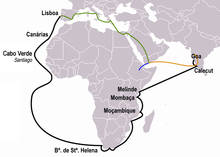
This figure illustrates the path of Vasco da Gama heading for the first time to India (black line)
The monopoly of maritime spice trade in the Indian Ocean stayed with Arabs during the
high and
late medieval periods. However, the dominance of Middle East traders got challenged in the European
Age of Discovery during which the spice trade, particularly in
black pepper, became an influential activity for European traders.
[63] Around the 15th century, the
Portuguese began to dominate the eastern shipping trade in general, and the spice-trade in particular, culminating in
Vasco Da Gama's arrival in
Kappad Kozhikode in 1498.
[64][65][66] The
Zamorin
of Calicut permitted the new visitors to trade with his subjects. The
Portuguese trade in Calicut prospered with the establishment of a
factory and fort in his territory. However, Portuguese attacks on Arab
properties in his jurisdiction provoked Zamorin and finally led to
conflicts between them. The Portuguese took advantage of the rivalry
between Zamorin and king of
Kochi; they allied with Kochi and when
Francisco de Almeida
was appointed as the Viceroy of Portuguese India in 1505, his
headquarters was at Kochi. During his reign, the Portuguese managed to
dominate relations with Kochi and established a few fortresses in
Malabar coast.
[67]
Nonetheless, the Portuguese suffered severe setbacks from the attacks
of Zamorin forces; especially from naval attacks under the leadership of
admirals of Calicut known as
Kunjali Marakkars, which compelled them to seek a treaty. In 1571, Portuguese were defeated by the Zamorin forces in the
battle at Chaliyam fort.
[68]
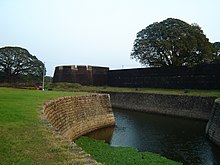
Tipu Sultan's fort at Palakkad; view from outside the northern wall.
The weakened Portuguese were ousted by the
Dutch East India Company, who took advantage of continuing conflicts between
Kozhikode and
Kochi to gain control of the trade.
[69] The Dutch in turn were weakened by constant battles with
Marthanda Varma of the
Travancore Royal Family, and were defeated at the
Battle of Colachel in 1741.
[70]
An agreement, known as "Treaty of Mavelikkara", was signed by the Dutch
and Travancore in 1753, according to which the Dutch were compelled to
detach from all political involvements in the region.
[71][72][73]
In the meantime, Marthanda Varma annexed many northern kingdoms through
military conquests, resulting in the rise of Travancore to a position
of preeminence in Kerala.
[74]
In 1766,
Hyder Ali, the ruler of
Mysore invaded northern Kerala.
[75] His son and successor,
Tipu Sultan,
launched campaigns against the expanding
British East India Company, resulting in two of the four
Anglo-Mysore Wars.
[76][77] Tipu ultimately ceded
Malabar District and
South Kanara to the Company in the 1790s; both were annexed to
Madras Presidency of
British India in 1792.
[78][79][80] The Company forged tributary alliances with Kochi in 1791 and Travancore in 1795.
[81]
Thus, by the end of 18th century, the whole of Kerala fell under the
control of the British, either administered directly or under
suzerainty.
[82]
There were major revolts in Kerala during its transition to democracy in the 20th century; most notable among them is the 1921
Malabar Rebellion and the many social struggles in
Travancore. In the
Malabar Rebellion, Mappila Muslims of Malabar rioted against Hindu
zamindars and the
British Raj.
[83] Some social struggles against caste inequalities also erupted in the early decades of 20th century, leading to the 1936
Temple Entry Proclamation that opened Hindu temples in Travancore to all castes;
[84]
Post colonial period
After
British India was
partitioned in 1947 into India and
Pakistan,
Travancore and
Cochin joined the
Union of India and on 1 July 1949 were merged to form
Travancore-Cochin.
[85] On 1 November 1956, the state of Kerala was formed by the
States Reorganisation Act merging the Malabar district, Travancore-Cochin (excluding four southern
taluks, which were merged with Tamil Nadu), and the taluk of
Kasargod,
South Kanara.
[86][87] In 1957, elections for the new Kerala Legislative Assembly were held, and
Communist-led government came to power, under
E. M. S. Namboodiripad.
[87] It was one of the first Communist government (In 1945,
San Marino, a sovereign state in Italy, elected the first
[88][89]), which was democratically elected in the world.
[90]
Geography
The state is wedged between the
Lakshadweep Sea and the
Western Ghats. Lying between north latitudes 8°18' and 12°48' and east longitudes 74°52' and 77°22',
[91] Kerala experiences the humid
equatorial tropic climate. The state has a coast of 590 km (370 mi)
[92] and the width of the state varies between 11 and 121 km (22–75 miles).
[93]
Geographically, Kerala can be divided into three climatically distinct
regions: the eastern highlands; rugged and cool mountainous terrain, the
central mid-lands; rolling hills, and the western lowlands; coastal
plains.
[94] The state is located at the extreme southern tip of the
Indian subcontinent and lies near the centre of the
Indian tectonic plate; hence, it is subject to comparatively low
seismic and volcanic activity.
[95] Pre-Cambrian and
Pleistocene geological formations compose the bulk of Kerala's terrain.
[96][97]
A catastrophic flood in Kerala in 1341 CE drastically modified its
terrain and consequently affected its history; it also created a natural
harbor for spice transport.
[98]

Coconut palms can be found all over Kerala
The eastern region of Kerala consists of high mountains, gorges and deep-cut valleys immediately west of the Western Ghats'
rain shadow.
[94] Forty-one of Kerala's west-flowing rivers,
[99] and three of its east-flowing ones originate in this region.
[100][101] The Western Ghats form a wall of mountains interrupted only near
Palakkad; hence also known Pal
ghat, where the
Palakkad Gap breaks through to provide access to the rest of India.
[102] The Western Ghats rise on average to 1,500 m (4920 ft) above sea level,
[103] while the highest peaks reach around 2,500 m (8200 ft).
[104] Anamudi, the highest peak in south India, is at an elevation of 2,695 metres (8,842 ft).
[105] The elevations of the eastern portions of the
Nilgiri Hills and
Palni Hills range from 250 and 1,000 m (820 and 3300 ft).
[106][107]

Silent Valley National Park
Kerala's western coastal belt is relatively flat to the eastern region,
[108] and is criss-crossed by a network of interconnected
brackish canals, lakes,
estuaries,
[109] and rivers known as the
Kerala Backwaters.
[110] The state's largest lake
Vembanad, dominates the Backwaters; it lies between
Alappuzha and Kochi and is more than 200 km
2 (77 sq mi) in area.
[111] Around 8% of India's waterways are found in Kerala.
[112] Kerala's
forty-four rivers include the
Periyar; 244 km,
Bharathapuzha; 209 km,
Pamba; 176 km,
Chaliyar; 169 km,
Kadalundipuzha; 130 km,
Chalakudipuzha; 130 km,
Valapattanam; 129 km and the
Achankovil River; 128 km. The average length of the rivers is 64 km. Many of the rivers are small and entirely fed by
monsoon rain.
[113] As Kerala's rivers are small and lacking in
delta, they are more prone to environmental effects. The rivers face problems such as sand mining and pollution.
[114] The state experiences several natural hazards like
landslides,
floods,
lightning and
droughts; the state was also affected by the
2004 Indian Ocean Tsunami.
[115]
Climate
With around 120–140 rainy days per year,
[116]:80 Kerala has a wet and maritime tropical climate influenced by the seasonal heavy rains of the
southwest summer monsoon and northeast winter monsoon.
[117]
Around 65% of the rainfall occurs from June to August corresponding to
the southwest monsoon, and the rest from September to December
corresponding to northeast monsoon.
[117] Southwest monsoon; The moisture-laden winds, on reaching the southernmost point of the
Indian Peninsula, because of its topography, become divided into two parts: the "Arabian Sea Branch" and the "Bay of Bengal Branch".
[118] The "Arabian Sea Branch" of the Southwest Monsoon first hits the
Western Ghats in Kerala,
[119] thus making the area the first state in
India to receive rain from the Southwest Monsoon.
[120][121]
Northeast monsoon: The distribution of pressure patterns is reversed
during this season and the cold winds from North India pick up moisture
from the Bay of Bengal and precipitate it in the east coast of
peninsular India.
[122][123] In Kerala, the influence of the northeast monsoon is seen in southern districts only.
[124]
Kerala's rainfall averages 3,107 mm (122 in) annually. Some of Kerala's
drier lowland regions average only 1,250 mm (49 in); the mountains of
eastern
Idukki district receive more than 5,000 mm (197 in) of
orographic precipitation:
the highest in the state. In eastern Kerala, a drier tropical wet and
dry climate prevails. During summer, the state is prone to gale force
winds, storm surges,
cyclone-related torrential downpours, occasional droughts, and rises in sea level.
[125]:26, 46, 52 The mean daily temperatures range from 19.8 °C to 36.7 °C.
[126] Mean annual temperatures range from 25.0–27.5 °C in the coastal lowlands to 20.0–22.5 °C in the eastern highlands.
[125]:65
| [hide]Climate data for Kerala |
| Month |
Jan |
Feb |
Mar |
Apr |
May |
Jun |
Jul |
Aug |
Sep |
Oct |
Nov |
Dec |
Year |
| Average high °C (°F) |
28.0
(82.4) |
30
(86) |
31
(88) |
32
(90) |
34
(93) |
34
(93) |
30
(86) |
29
(84) |
29
(84) |
30
(86) |
30
(86) |
31
(88) |
34
(93) |
| Average low °C (°F) |
22
(72) |
23
(73) |
24
(75) |
25
(77) |
25
(77) |
24
(75) |
23
(73) |
23
(73) |
23
(73) |
23
(73) |
23
(73) |
22
(72) |
22
(72) |
| Source: [126] |
Flora and fauna

Brahminy Kite, commonly known as Krishnapparunthu in the local language of Kerala
Most of the biodiversity is concentrated and protected in the
Western Ghats. Out of the 4,000
flowering plant species 900 species are
medicinal plants; 1,272 of which are
endemic to Kerala and 159 threatened.
[129]:11 Its 9,400 km
2 of forests include tropical wet evergreen and semi-evergreen forests (lower and middle elevations—3,470 km
2), tropical moist and dry deciduous forests (mid-elevations—4,100 km
2 and 100 km
2, respectively), and montane subtropical and
temperate (
shola) forests (highest elevations—100 km
2). Altogether, 24% of Kerala is forested.
[129]:12 Two of the world's
Ramsar Convention listed
wetlands—
Lake Sasthamkotta and the
Vembanad-Kol wetlands—are in Kerala, as well as 1455.4 km
2 of the vast
Nilgiri Biosphere Reserve. Subjected to extensive clearing for cultivation in the 20th century,
[130]:6–7 much of the remaining forest cover is now protected from
clearfelling.
[131] Eastern Kerala's windward mountains shelter
tropical moist forests and
tropical dry forests, which are common in the Western Ghats.
[132][133]
Kerala's fauna are notable for their diversity and high rates of endemism: it includes 102 species of
mammals (56 of which are endemic),
476 species of birds, 202 species of freshwater fishes, 169 species of
reptiles (139 of them endemic), and 89 species of
amphibians (86 endemic).
[134] These are threatened by extensive habitat destruction, including soil erosion, landslides,
salinisation, and resource extraction. In the forests,
sonokeling,
Dalbergia latifolia,
anjili,
mullumurikku,
Erythrina, and
Cassia number among the more than 1,000 species of trees in Kerala. Other plants include
bamboo, wild black pepper, wild
cardamom, the
calamus rattan palm, and aromatic
vetiver grass,
Vetiveria zizanioides.
[129]:12 Indian Elephant,
Bengal Tiger,
Indian Leopard,
Nilgiri Tahr,
Common Palm Civet, and
Grizzled Giant Squirrel are also found in the forests.
[129]:12, 174–175 Reptiles include the
King Cobra,
viper,
python, and
Mugger Crocodile. Kerala's birds include legion—
Malabar Trogon, the
Great Hornbill,
Kerala Laughingthrush,
Darter,
Southern Hill Myna and several emblematic species. In lakes, wetlands, and waterways, fish such as
kadu;
stinging catfish and
Choottachi; Orange chromide—
Etroplus maculatus are found.
[129]:163–165
Subdivisions

Population density map of Kerala
The state's 14 districts are distributed among Kerala's six regions:
North Malabar (far-north Kerala), South Malabar (northern Kerala),
Kochi (central Kerala),
Northern Travancore,
Central Travancore (southern Kerala) and
Southern Travancore
(far-south Kerala). The districts which serve as the administrative
regions for taxation purposes, are further subdivided into 75
taluks;
these have fiscal and administrative powers over settlements within
their borders, including maintenance of local land records.
Taluks of Kerala are further divided into 1453 revenue villages.
[135]
Consequent to the 73rd and 74th Amendment to the Constitution of India,
the Local self-government Institutions are to function as the third
tier of Government and it constitutes 14 District Panchayats, 152 Block
Panchayats, 978 Grama Panchayats, 60 Municipalities, 5 Corporations and 1
Township.
[136] Mahé, a part of the Indian union territory of
Puducherry,
[137] though 647 km away from it,
[138] is a coastal exclave surrounded by Kerala on all of its landward approaches.
[139]
In India, self-governance of the major cities rests with
Municipal corporations; there are five such bodies governing
Thiruvananthapuram,
Kochi,
Kozhikode,
Kollam and
Thrissur.
[140] Kochi metropolitan area is the largest
urban agglomeration in Kerala.
[141]
According to a survey by economics research firm, Indicus Analytics,
Thiruvananthapuram, Kozhikode, Kochi, Thrissur and Kannur found place in
the 10 best cities in India to spend life; the survey used parameters
such as health, education, environment, safety, public facilities and
entertainment to rank the cities.
[142]
Government and administration

Kerala State Legislative Assembly or the Niyamasabha

A working day view of Kerala High Court in
Kochi
Kerala hosts two major political alliances: the
United Democratic Front (India) (UDF); led by the
Indian National Congress and the
Left Democratic Front (Kerala) (LDF); led by the
Communist Party of India (Marxist) (CPI(M)). At present, the UDF is the ruling coalition in government;
Oommen Chandy of the Indian National Congress is the Chief Minister while
V.S. Achuthanandan of the LDF is the
Leader of Opposition. Strikes, protests and marches are ubiquitous in Kerala because of the comparatively strong presence of labour unions.
[143][144] According to the
Constitution of India, Kerala has a
parliamentary system of
representative democracy for its governance;
universal suffrage is granted to state residents.
[145] The government structure is organised into the three branches:
- Legislature: The unicameral legislature, the Kerala Legislative Assembly,
comprises elected members and special office bearers; the Speaker and
Deputy Speaker elected by the members from among themselves. Assembly
meetings are presided over by the Speaker and in the Speaker's absence,
by the Deputy Speaker. The state has 140 assembly constituencies.[146] The state elects 20 and nine members for representation in the Lok Sabha and the Rajya Sabha respectively.[147]
- Executive: The Governor of Kerala is the constitutional head of state, and is appointed by the President of India.[148] Sheila Dikshit is the Governor of Kerala.[149] The executive authority is headed by the Chief Minister of Kerala, who is the de facto
head of state and is vested with extensive executive powers; the head
of the party attaining majority in the Legislative Assembly is appointed
to the post by the Governor.[148] The Council of Ministers, has its members appointed by the Governor, taking the advice of the Chief Minister.[148] Auxiliary authorities known as panchayats, for which local body elections are regularly held, govern local affairs.[150]
- Judiciary: The judiciary consists of the Kerala High Court and a system of lower courts.[151] The High Court, located at Kochi,[152] has a Chief Justice along with 23 permanent and seven additional pro tempore justices as of 2012.[153] The high court also hears cases from the Union Territory of Lakshadweep.[154][155]
The local self-government bodies; Panchayat, Municipalities and
Corporations existed in Kerala since 1959, however, the major initiative
to decentralise the governance was started in 1993, conforming to the
constitutional amendments of central government in this direction.
[156] With the enactment of
Kerala Panchayati Raj Act and
Kerala Municipality Act in the year 1994, the state implemented various reforms in the local self-governance.
[157] Kerala Panchayati Raj Act envisages a 3-tier system of local-government with
Gram panchayat,
Block panchayat and
District Panchayat forming a hierarchy.
[158] The acts ensure clear demarcation of power among these institutions.
[156]
However, Kerala Municipality Act envisages a single-tier system for
urban areas, with the institution of municipality designed at par with
Gram panchayat of the former system. Substantial administrative, legal
and financial powers are delegated to these bodies to ensure efficient
decentralisation.
[159] As per the present norms, the state government devolves about 40 per cent of the state plan outlay to the local government.
[160]
Economy

Rural women processing coir threads
After independence, the state was managed as a
democratic socialist welfare economy. From the 90s,
liberalisation of the
mixed economy allowed onerous
Licence Raj restrictions against capitalism and
foreign direct investment to be lightened, leading to economic expansion and increase in employment. In the fiscal years 2007–2008, the nominal
gross state domestic product (GSDP) was
 162414.79 crore
(US$27 billion). GSDP growth; 9.2% in 2004–2005 and 7.4% in 2003–2004
had been high compared to average of 2.3% annually in the 80s and
between 5.1%
[161]:8 and 5.99%
[162] in the 90s.
[161]:8 The state recorded 8.93% growth in enterprises from 1998 to 2005, higher than the nation's rate of 4.80%.
[163] Human Development Index rating is the highest in India; 0.790.
[164] This apparently paradoxical "Kerala phenomenon" or "
Kerala model of development" of very high human development and not much high economic development resulted due to a stronger service sector.
[125]:48[165]:1
Kerala's economy depends on
emigrants working in foreign countries, mainly in the
Gulf states countries such as
United Arab Emirates or
Saudi Arabia), and
remittances annually contribute more than a fifth of GSDP.
[166] As of 2008, the Gulf countries altogether had a Keralite population of more than 2.5 million, who send home annually a sum of
US$6.81 billion, which is more than 15.13% of
remittance to India in 2008; the highest among
Indian states.
[167]
Of the $71 billion in remittances sent to India in 2012, Kerala still
received the highest among the states: $11.3 billion, which is nearly
16%.
[168]
According to a study commissioned by the
Kerala State Planning Board, the state should look for other reliable sources instead of relying on remittances to finance its expenditure.
[169]
Tertiary sector, comprising transport, storage, communications,
tourism, banking and insurance, real estate and other services,
contributed 63.22% of the state GDP in 2011-2012. Agriculture and allied
sectors contributed 15.73% while manufacturing, construction and
utilities contributed only 21.05% of the GDP.
[170][171] Nearly half of Kerala's people are dependent on agriculture alone for income.
[172] Around 600 varieties
[129]:5 of rice which are Kerala's most important
staple food and cereal crop
[173]:5 are harvested from 3105.21 km
2; a decline from 5883.4 km
2 in 1990
[173]:5. While, 688,859
tonne paddy are produced per annum.
[174] Other key crops include coconut; 899,198 ha, tea, coffee; 23% of Indian production,
[175]:13 or 57,000 tonnes
[175]:6–7), rubber, cashews, and
spices—including pepper,
cardamom,
vanilla, cinnamon, and nutmeg. Around 1.050 million fishermen haul an
annual catch of 668,000 tonnes as of 1999–2000 estimate; 222 fishing
villages are strung along the 590 km coast. Another 113 fishing villages
dot the hinterland. Kerala's coastal belt of
Karunagappally is known for high background radiation from
thorium-containing
monazite sand. In some coastal panchayats, median outdoor radiation levels are more than 4
mGy/yr and, in certain locations on the coast, it is as high as 70 mGy/yr.
[176]
Traditional industries manufacturing items;
coir,
handlooms, and
handicrafts employ around one million people.
[177] As per the 2006-07 census by
SIDBI there are 1,468,104
Micro, Small and Medium Enterprises in Kerala employing 3,031,272 people.
[178][179] The
KSIDC has promoted more than 650 medium and large manufacturing firms in Kerala generating employment for 72,500 people.
[180] A small mining sector of 0.3% of GSDP involves extraction of
ilmenite,
kaolin,
bauxite,
silica,
quartz,
rutile,
zircon, and
sillimanite.
[174] Home gardens and animal husbandry also provide work for many people. Other major sectors are
tourism, manufacturing, and
business process outsourcing.
As of March 2002, Kerala's banking sector comprised 3341 local
branches; each branch served 10,000 persons, lower than the national
average of 16,000; the state has the third-highest bank penetration
among Indian states.
[181] On 1 October 2011, Kerala became the first state in the country to have at least one banking facility in every village.
[182] Unemployment in 2007 was estimated at 9.4%;
[183] underemployment, low employability of youths, and a 13.5% female
participation rate are chronic issues,
[184]:5, 13 as is the practice of
Nokku kooli, 'wages for looking on'.
[185] By 1999–2000, the rural and urban poverty rates dropped to 10.0% and 9.6% respectively.
[186]
Technopark, Trivandrum is the largest IT employer in Kerala and employs 35,000 people. It was the first technology park in India
[187][188] and with the inauguration of the Thejaswini complex on 22 February 2007, Technopark became the largest IT Park in India.
[189] Software giants like
Infosys,
Oracle,
TCS,
Capgemini,
HCL,
UST Global,
Nest,
Suntec,
IBS etc. have offices here.
[190] Trivandrum is also the IT Hub of Kerala and hold around 80% of the software exports.
[191] Another IT Park, Technocity is also in the making . The
Grand Kerala Shopping Festival (GKSF) claimed to be Asia's largest shopping festival was started in the year 2007.
[192] Since then it has become an annual shopping event being conducted in the December–January period.
The state's budget of 2012–2013 is
481.42 billion.
[193] The state government's tax revenues (excluding the shares from Union tax pool) amounted to
217.22 billion in 2010–2011; up from
176.25 billion in 2009–2010. Its
non-tax revenues (excluding the shares from Union tax pool) of the Government of Kerala reached
19,308 million in 2010–2011.
[193]
However, Kerala's high ratio of taxation to GSDP has not alleviated
chronic budget deficits and unsustainable levels of government debt,
which have impacted social services.
[194] A record total of 223
hartals were observed in 2006, resulting in a revenue loss of over
2000
crore (
20 billion).
[195]
Agriculture

A typical paddy field in Kerala
Agriculture in Kerala has passed through many phases. The major
change occurred in the 1970s, when production of rice reduced due to
increased availability of rice supply all over India and decreased
availability of labour supply.
[196]
Consequently, investment in rice production decreased and a major
portion of the land shifted to the cultivation of perennial tree crops
and seasonal crops.
[197][198]
Profitability of crops is reducing due to shortage of farm labour, the
high price of land and the uneconomic size of operational holdings.
[199]
Kerala produces 97% of the national output of
black pepper[200] and accounts for 85% of the area under
natural rubber in the country.
[201][202] Coconut,
tea,
coffee,
cashew, and
spices—including
cardamom,
vanilla,
cinnamon, and
nutmeg—comprise a critical agricultural sector.
[203][204][205][206][207][208] The key agricultural staple is rice, with varieties grown in extensive paddy fields.
[209] Home gardens comprise a significant portion of the agricultural sector.
[210] Related
animal husbandry
is also important, and is touted by proponents as a means of
alleviating rural poverty and unemployment among women, the
marginalised, and the landless.
[211][212] The state government promotes these activity via educational campaigns and the development of new cattle breeds such as the
Sunandini.
[213][214][215]
Though the contribution of agricultural sector to the state economy
was on the decline in 2012-13, under the strength of the allied
livestock sector, it has picked up from 7.03% (2011–12) to 7.2%. In the
current fiscal(2013–14), the contribution has been estimated at a high
of 7.75%. The total growth of farm sector has recorded a 4.39% increase
in 2012-13, over a paltry 1.3% growth in the previous fiscal.The primary
sector comprising agriculture has only a share of 9.34% in the sectoral
distribution of Gross State Domestic Product at Constant Price, whereas
the secondary and tertiary sectors has contributed 23.94% and 66.72%
respectively.
Fisheries

A fisherman in rural Kerala
With 590 km of coastal belt,
[216] 400,000 hectares of inland water resources
[217] and about 220,000 active fishermen,
[218] Kerala is one of the leading producers of fish in India.
[219]
According to 2003–04 reports, about 1.1 million people earn their
livelihood from fishing and allied activities such as drying,
processing, packaging, exporting and transporting fisheries. The annual
yield of the sector was estimated as 608,000 tons in 2003–04.
[220]
This contributes to about 3% of the total economy of the state. In
2006, about 22% of the total Indian marine fishery yield was from the
state.
[221]
During the southwest monsoon, a suspended mud bank would be developed
along the shore, which in turn leads to calm ocean water and hence peak
output from the fishery industry. This phenomenon is locally called
chakara.
[222][223] The fish landings consist of a large variety:
pelagic species; 59%,
demersal species; 23%,
crustaceans and
molluscs.
[221]
Transport
Roads

KSRTC is the major agency providing long-haul public bus service in South Kerala.
Kerala has 145,704 kilometres (90,536 mi) of roads; it accounts for
4.2% of India's total. This translates to about 4.62 kilometres
(2.87 mi) of road per thousand population, compared to an average of
2.59 kilometres (1.61 mi) in the country. Roads in Kerala include
1,524 km of national highway; it is 2.6% of the nation's total,
4341.6 km of state highway and 18900 km of district roads.
[224] Most of Kerala's west coast is accessible through two
national highways:
NH 47 and
NH 17, and the eastern side is accessible through various state highways.
[225] There is also a
hill highway proposed, to make easy access to eastern hills.
[226] National Highway 17 with the longest stretch of 421 km connects
Edapally to
Panvel; it starts from
Kochi and passes through
Kozhikode,
Kannur and
Kasaragod before entering
Karnataka.
[225]
The
Department of Public Works is responsible for maintaining and expanding the
state highways system and major district roads.
[227] The Kerala State Transport Project (KSTP), which includes the
GIS-based
Road Information and Management Project (RIMS), is responsible for
maintaining and expanding the state highways in Kerala; it also oversees
a few major district roads.
[228][229]
Traffic in Kerala has been growing at a rate of 10–11% every year,
resulting in high traffic and pressure on the roads. Road density is
nearly four times the national average, reflecting the state's high
population density. Kerala's annual total of road accidents is among the
nation's highest. The accidents are mainly the result of the narrow
roads and irresponsible driving.
[230]
National Highways in Kerala are the narrowest compared to other parts
of the country and will remain so for unforeseeable future, as Kerala
state government has requested and got special approval(exemption) for
narrow national highways in the state compared to other parts of the
country. In Kerala, highways will be 45-meters wide, where as in other
states National Highways are minimum 4 lane, 60-meters wide, grade
separated highways as well as 6/8 lane access-controlled expressways.
[231][232]
NHAI has threatened the kerala state government that it will give high
priority to other states in highway development as political commitment
to the better highways has been lacking from the government,
[233] although State had the highest road accident rate in the country, with most fatal accidents taking place along the State’s NHs.
[234]
Railways
The
Indian Railways'
Southern Railway line runs through the state connecting most of the major towns and cities except those in the highland districts of
Idukki and
Wayanad.
[235] The railway network in the state is controlled by two out of six divisions of
Southern Railway;
Thiruvananthapuram Railway division and
Palakkad Railway Division.
[236] Thiruvananthapuram Central (TVC) is the busiest railway station in the state. Kerala's major railway stations are
Kannur (CAN),
Kozhikode (CLT),
Tirur (TIR),
Shornur Junction (SRR),
Palakkad Junction (PGT),
Thrissur Railway Station (TCR),
Angamaly (AFK),
Aluva (AWY),
Ernakulam Town (North) (ERN),
Ernakulam Junction (South) (ERS),
Alappuzha (ALLP),
Kottayam (KTYM),
Tiruvalla (TRVL),
Chengannur (CNGR),
Kayamkulam Junction (KYJ),
Kollam Junction (QLN) and
Thiruvananthapuram Central (TVC).
Major railway transport between
Beypore–
Tirur began on 12 March 1861, from
Shoranur–Cochin Harbour section in 1902, from
Shenkottai–
Punalur on 26 November 1904, from
Nilambur-
Shoranur in 1927, from
Punalur–
Thiruvananthapuramon 4 November 1931, from
Ernakulam–
Kottayam in 1956, from
Kottayam–
Kollam in 1958, from
Thiruvananthapuram–Kanyakumari in 1979 and from
Thrissur-Guruvayur Section in 1994.
[237]
Airports

State Water Transport Department is the main agency providing inland water transport facilities.
Kerala has three international airports;
Cochin International Airport,
Trivandrum International Airport and
Calicut International Airport. Two international airports were proposed, at
Kannur and
Pathanamthitta as of 2008.
[238] Officials say that the
Kannur International Airport will be completed in December 2015 and will make Kerala the only state in the country to have four international airports.
[239][240] The
Cochin International Airport is the largest and busiest in the state, and was the first Indian airport to be incorporated as a
public limited company; it was funded by nearly 10,000
non-resident Indians from 30 countries.
[241]
Inland water transport

Junkar Service Fort Cochin
As Kerala has numerous
backwaters, waterways are used for commercial
inland navigation. The transportation is mainly done with country craft and passenger vessels.
[198] There are 67 navigable rivers in the state. The total length of the inland waterways in the state is 1687 km.
[242]
The main constraints to the expansion of inland navigation are lack of
depth in the waterway caused by silting, lack of maintenance of
navigation system and bank protection, accelerated growth of the
water hyacinth, lack of modern inland craft terminals, and lack of a cargo handling system.
[198] A 205 km canal,
National Waterway 3, runs between Kottapuram and Kollam.
[243]
Demographics
Kerala is home to 2.76% of India's population; at 859 persons per km
2, its land is nearly three times as densely settled as the rest of India, which is at a population density of 370 persons per km
2.
[247]
Trivandrum is the largest and most populous city in Kerala. In the
state, the rate of population growth is India's lowest, and the decadal
growth of 4.9% in 2011 is less than one third of the all-India average
of 17.64%.
[247]
Kerala's population more than doubled between 1951 and 1991 by adding
15.6 million people to reach 29.1 million residents in 1991; the
population stood at 33.3 million by 2011.
[247] Kerala's coastal regions are the most densely settled with population density of coastal districts being 2022 persons per km
2, 2.5 times the overall population density of the state, 859 persons per km
2, leaving the eastern hills and mountains comparatively sparsely populated.
[248] Around 31.8 million Keralites are predominantly
Malayali.
[249] State's 321,000 indigenous tribal
Adivasis, 1.10% of the population, are concentrated in the east.
[250]:10–12 Malayalam, one of the classical languages in India, is Kerala's
official language,
[251] however
Tamil is also widely understood.
[252][253][254] Kannada,
Tulu,
Hindi,
Bengali,
Mahl and various
Adivasi (tribal) languages are also spoken.
[253][255][256][257]
As of early 2013, there are close to 2.5 million (7.5% of state
population) migrant workers from other states of India in Kerala.
[258]
Languages of Kerala in 2001
[259]
Malayalam (96.74%)
Tamil (1.87%)
Others (1.39%)
Religion
In comparison with the rest of India, Kerala experiences relatively little
sectarianism.
[260] According to 2001
Census of India figures, 56.2% of Kerala's residents are
Hindus, 24.7% are
Muslims, 19% are
Christians, and the remaining 0.1% follows other religions.
[261] The major Hindu castes are
Dalit,
Ezhava,
Thiyya,
Nadars,
Nair and
Nambudiri. The rest of the Hindu castes, including those in the list of
Other Backward Class (OBC), are minority communities.
Islam and
Judaism arrived in Kerala through Arab traders.
[262] Muslims of Kerala, generally referred to as
Moplahs, mostly follow the
Shafi'i Madh'hab under
Sunni Islam.
[263] The major Muslim organisations are
Sunni,
Mujahid and
Jama'at-e-Islami.
[264] Christianity is believed to have reached the shores of Kerala in 52 AD with the arrival of
St Thomas, one of the
Twelve Apostles of
Jesus Christ.
[265][266] Saint Thomas Christians include
Syro-Malabar Catholic,
[267] Syro-Malankara Catholic,
[268] Malankara Orthodox,
[269] Jacobite[270] and
Marthoma.
[271] Latin Rite Christians were converted by the
Portuguese in the 16th and 19th centuries,
[126][272] mainly from communities where fishing was the traditional occupation.
[273] A significant
Jewish community existed in Kerala until the 20th century, when most of them
migrated to Israel.
[274] Jainism has a considerable following in the
Wayanad district.
[275][276] Buddhism was dominant at the time of
Ashoka the Great but vanished by the 8th century CE.
[277]
The
Paradesi Synagogue at Kochi is the oldest synagogue in the
Commonwealth.
[278] Certain Hindu communities such as the
Kshatriyas,
Nairs,
Tiyyas and the
Muslims around
North Malabar used to follow a traditional matrilineal system known as
marumakkathayam,
[279][280] although this practice ended in the years after Indian independence.
[281] Other
Muslims, Christians, and some Hindu castes such as the Namboothiris and the Ezhavas followed
makkathayam, a patrilineal system.
[282][283][284] Owing to the former matrilineal system, women in Kerala enjoy a high social status.
[285] However, gender inequality among low caste men and women is reportedly higher compared to that in other castes.
[286] :1
| Thiruvananthapuram |
3,307,284 |
65.19% |
21.44% |
13.37% |
| Kollam |
2,629,703 |
61.23% |
19.36% |
19.41% |
| Pathanamthitta |
1,195,537 |
46.35% |
49.07% |
4.58% |
| Alapuzha |
2,121,943 |
66.16% |
23.96% |
9.88% |
| Kottayam |
1,979,274 |
43.37% |
51.65% |
5.98% |
| Idukki |
1,107,453 |
45.24% |
47.56% |
7.20% |
| Ernakulam |
3,279,860 |
43.59% |
41.84% |
14.57% |
| Thrissur |
3,110,327 |
55.31% |
28.24% |
16.45% |
| Palakkad |
2,810,892 |
66.92% |
6.18% |
26.90% |
| Malappuram |
4,110,956 |
28.44% |
4.72% |
66.84% |
| Kozhikkode |
3,089,543 |
55.04% |
7.43% |
37.53% |
| Wayanad |
816,558 |
49.44% |
23.57% |
26.72% |
| Kannur |
2,525,637 |
59.51% |
12.84% |
27.65% |
| Kasargod |
1,302,600 |
55.61% |
10.06% |
34.33%[287] |
Gender
There are a number of possible explanations for the position of women
in Kerala. One is the rise of communist governing bodies in Kerala.
These governments helped to distribute land and implement education
reforms. Another explanation is a tradition of matrilineal inheritance
in Kerala.
[285]
This was common among certain influential castes and is a factor in the
value placed on daughters. Christian missionaries also influenced
Malayali women in that they started schools for girls from poor
families. Opportunities for women like education and gainful employment
often translate into a lower birth rate, which in turn, makes education
and employment more likely to be accessible and more beneficial for
women. This creates an upward spiral for both the women and children of
the community that is passed on to future generations of both boys and
girls. Low birth rate and high literacy rate are often the twin
hallmarks of the healthy advancement of a society.
While having the opportunities that education affords them such as
participating in politics, keeping up to date on news, reading religious
texts, etc., these tools have not translated into full, equal rights
for the women of Kerala. At Cochin University women must be in their
hostels by dark, while men are free to roam at any hour. There is a
general attitude that women must be restricted for their own benefit.
Women who break the rules are often looked down on. Kerala is a state in
flux where, despite the social progress made so far, gender still
influences social mobility.
[288][289][290]
Human Development Index
As of 2011 Kerala has a
Human Development Index (HDI) of 0.790 which comes under the "very high" category and it is the highest in the country.
[3]
Comparatively higher spending of the government in primary level
education, health care and elimination of poverty from the 19th century
onward had helped the state to keep a very high HDI;
[291][292] report was prepared by the central government's Institute of Applied Manpower Research.
[293][294]
However, the Human Development Report, 2005 prepared by Centre for
Development Studies envisages a virtuous phase of inclusive development
for the state since the advancement in human development had already
started aiding the economic development of the state.
[291]
According to a 2005–2006 national survey, Kerala has the highest literacy rate among Indian states; 93.91%.
[295] Life expectancy of 74 years was among the highest in India as of 2011.
[296]
Kerala's rural poverty rate fell from 59% (1973–1974) to 12%
(1999-2010); the overall (urban and rural) rate fell 47% between the
1970s and 2000s against the 29% fall in overall poverty rate in India.
[297] By 1999–2000, the rural and urban poverty rates dropped to 10.0% and 9.6% respectively.
[186]
These changes stem largely from efforts begun in the late 19th century
by the kingdoms of Cochin and Travancore to boost social welfare.
[298][299] This focus was maintained by Kerala's post-independence government.
[125][164]:48 The
United Nations Children's Fund (UNICEF) and the
World Health Organisation designated Kerala the world's first "
baby-friendly state" because of its effective promotion of breast-feeding over formulas.
[300]
Third National Family Health Survey ranks Kerala first in the list of
"Institutional Delivery" with 100% births in medical facility.
[301] Ayurveda (both elite and popular forms),
[302]:13 siddha, and many endangered and endemic modes of
traditional medicine, including
kalari,
marmachikitsa and
vishavaidyam, are practised. Some occupational communities such as
Kaniyar
were known as native medicine men in relation with practice of such
streams of medical systems, apart from their traditional vocation.
[303] These propagate via
gurukula discipleship,
[302]:5–6 and comprise a fusion of both medicinal and supernatural treatments.
[302]:15
Kerala has undergone the "
demographic transition" characteristic of such
developed nations as Canada, Japan, and Norway.
[165]:1 as 11.2% of people are over the age of 60,
[164] and due to the low birthrate of 18 per 1,000.
[304] In 1991, Kerala's
total fertility rate (TFR) was the lowest in India. Hindus had a TFR of 1.66, Christians; 1.78, and Muslims; 2.97.
[305] The
sub-replacement fertility level and
infant mortality rate are lower compared to those of other states; estimated from 12
[125][304]:49 to 14
[306]:5
deaths per 1,000 live births. According to Human Development Report
1996, Kerala's Gender Development Index was reported to be 597; higher
than any other state of India. Many factors, such as high rates of
female literacy, education, work participation and life expectancy,
along with favourable
female-to-male ratio, had contributed to it.
[307] Kerala's
female-to-male ratio of 1.058 is higher than that of the rest of India.
[165]:2.
The state also is regarded as the "least corrupt Indian state"
according to the surveys conducted by Transparency International (2005)
[308] and India Today (1997)
[309]
Kerala is the cleanest and healthiest state in India.
[310] However, Kerala's
morbidity rate
is higher than that of any other Indian state—118 (rural) and 88
(urban) per 1,000 people. The corresponding figures for all India were
55 and 54 per 1,000 respectively as of 2004.
[306]:5 Kerala's 13.3%
prevalence of low
birth weight is higher than that of
First World nations.
[304] Outbreaks of
water-borne diseases such as
diarrhoea,
dysentery,
hepatitis, and
typhoid among the more than 50% of people who rely on 3 million
water wells is an issue worsened by the lack of
sewers.
[311]:5–7
In respect of women empowerment, some negative factors such as higher
suicide rate, lower share of earned income, complaints of sexual
harassment and limited freedom are reported.
[307]
Education

Hardware training for students given by "IT@SCHOOL" project
The
Kerala school of astronomy and mathematics
flourished between the 14th and 16th centuries. In attempting to solve
astronomical problems, the Kerala school independently created a number
of important mathematics concepts including results—series expansion for
trigonometric functions.
[312][313] Following the instructions of the
Wood's despatch
of 1854, both the princely states, Travancore and Cochin, launched mass
education drives with the support from different agencies mainly based
on castes and communities and introduced a system of
grant-in-aid to attract more private initiatives.
[314] The efforts by leaders,
Vaikunda Swami,
Narayana Guru and
Ayyankali, towards the socially discriminated castes in the state, with the help of community-based organisations like
Nair Service Society,
SNDP,
Muslim Mahajana Sabha, Yoga Kshema Sabha (of Nambudiris) and different
congregations of Christian churches, led to developement in the mass
education of Kerala.
[314]
In 1991, Kerala became the first state in India to be recognised as a
completely literate state, though the effective literacy rate at that
time was only 90%. As of 2007, the net enrollment in elementary
education was almost 100 per cent and was almost balanced among
different sexes, social groups and regions, unlike other states of
India.
[315] The state topped the Education Development Index (EDI) among 21 major states in India in the year 2006–2007.
[316]
According to the first Economic Census, conducted in 1977, 99.7% of the
villages in Kerala had a primary school within 2 km, 98.6% had a middle
school within 2 km and 96.7% had a high school or higher secondary
school within 5 km.
[317]
The educational system prevailing in the state schooling is for 10
years, which are streamlined into lower primary, upper primary and
secondary school stages with a
4+3+3 pattern.
[315] After 10 years of secondary schooling, students typically enroll in
Higher Secondary Schooling in one of the three major streams—
liberal arts,
commerce or science.
[318]
Upon completing the required coursework, students can enroll in general
or professional under-graduate (UG) programmes. The majority of the
public schools are affiliated with the
Kerala State Education Board. Other familiar educational boards are the
Indian Certificate of Secondary Education (ICSE), the
Central Board for Secondary Education (CBSE), and the
National Institute of Open Schooling
(NIOS). English is the language of instruction in most self-financing
schools, while government and government-aided schools offer English or
Malayalam.
[318] Though the education cost is generally considered low in Kerala,
[319]
according to the 61st round of the National Sample Survey (2004–2005),
per capita spending on education by the rural households in Kerala was
reported to be
41
for Kerala, more than twice the national average. The survey also
revealed that the rural-urban difference in the household expenditure on
education was much less in Kerala than in the rest of India.
[320]
Universities in Kerala are
Central University of Kerala,
Kannur University,
Mahatma Gandhi University,
University of Calicut,
National University of Advanced Legal Studies,
University of Kerala,
Cochin University of Science and Technology,
Kerala Agricultural University,
Aligarh Muslim University Malappuram,
Thunchath Ezhuthachan Malayalam University,
Sree Sankaracharya University of Sanskrit,
EFLU Malappuram Campus,
and an Islamic university (Darul Huda Islamic university). Premier educational institutions in Kerala are the
Indian Institute of Management, Kozhikode,
National Institute of Technology Calicut (NITC), the
Indian Institute of Space Science and Technology, Trivandrum
(IIST), The Indian Institute of Science Education and Research,
Thiruvananthapuram (IISER-TVM) and College of Engineering, Trivandrum
(Trivandrum)
Culture
During
Onam, Kerala's biggest celebration, Keralites create
pookkalam (floral carpet) designs in front of their houses.
The culture of Kerala is composite and cosmopolitan in nature and it's an integral part of
Indian culture.
[21] It has been elaborated through centuries of contact with neighboring and overseas cultures.
[321]
However, the geographical insularity of Kerala from the rest of the
country has resulted in development of a distinctive lifestyle, art,
architecture, language, literature and social institutions.
[21] There are around 10,000 festivals celebrated in the state.
[322] The
Malayalam calendar, a solar calendar started from 825 CE in Kerala,
[323] finds common usage in planning agricultural and religious activities.
[324]
Onam
Onam (Malayalam: ഓണം) is a harvest festival celebrated by the people
of Kerala, India.[1] It is also the state festival of Kerala with State
holidays on 4 days starting from Onam Eve (Uthradom) to the 4th Onam
Day. Onam Festival falls during the Malayalam month of Chingam (Aug -
Sep) and marks the commemoration of
Vamana
avatara of Vishnu and the subsequent homecoming of King Mahabali. Onam
is reminiscent of Kerala's agrarian past, as it is considered to be a
harvest festival.
The festival falls during the Malayalam month of Chingam (Aug - Sep) and marks the homecoming of the mythical King
Mahabali
who Malayalees consider as their King. It is one of the festivals
celebrated with most number of cultural elements. Some of them are
Vallam Kali, Pulikkali, Pookkalam, Onatthappan, Thumbi Thullal,
Onavillu, Kazhchakkula, Onapottan,[2] Atthachamayam etc.
Temple Festivals
Kerala has a large number of Hindu temples. Many of the temples have
unique traditions and most hold festivals on specific days of the year.
Temple festivals usually continue for a number of days. A common
characteristic of these festivals is the hoisting of a holy flag which
is then brought down only on the final day of the festival. Some
festivals include Poorams, the most famous of these being the
Thrissur Pooram.
Temples that can afford it will usually involve at least one richly
caparisoned elephant as part of the festivities. The idol of the God in
the temple is taken out on a procession around the country side atop
this elephant. When the procession visits homes around the temple,
people will usually present rice, coconuts, and other offerings to the
God. Processions often include traditional music such as
Panchari melam or
Panchavadyam.
The major Hindu temple festivals in the state are
Makaravilakku at
Sabarimala, Nenmara Vallangi Vela,
Thrissur Pooram,
Attukal Pongala in
Trivandrum's famous
Attukal Temple, Vrishchikotsavam in Tripunithura
Sree Poornathrayeesa temple, Utsavams in
Padmanabha swami temple at Trivandrum, Ashtami at
Vaikom temple, Kodungalloor Bharani, Chettikulangara Bharani at Mavelikkara,
Guruvayoor Anayottam, Chottanikkara Makam and
Sivarathri festival in
Aluva temple and
Padanilam temple at
Mavelikkara, Maradu Thalappoli at
Maradu.
Dance
Main article:
Arts of Kerala
Kerala is home to a number of
performance arts. These include five classical dance forms:
Kathakali,
Mohiniyattam,
Koodiyattom,
Thullal and
Krishnanattam, originated and developed in the temple theatres during the classical period under the patronage of royal houses.
[325] Kerala natanam,
Kaliyattam,
Theyyam,
Koothu and
Padayani are other dance forms associated with the temple culture of the region.
[326] Some traditional dance forms such as
Margamkali, Parichamuttu and
Chavittu nadakom are popular among the Christians,
[327][328][329] while
Oppana and
Duffmuttu are popular among the Muslims of the state.
[327][330]
Music
Development of classical music in Kerala is attributed to the
contributions it received from the traditional performance arts
associated with the temple culture of Kerala.
[331] Development of the indigenous classical music form,
Sopana Sangeetham, illustrates the rich contribution that temple culture has made to the arts of Kerala.
[331] Carnatic music dominates Keralite traditional music. This was the result of
Swathi Thirunal Rama Varma's popularisation of the genre in the 19th century.
[321] Raga-based renditions known as
sopanam accompany
kathakali performances.
[332] Melam; including the
paandi and
panchari variants, is a more percussive style of music:
[333] it is performed at
Kshetram-centered festivals using the
chenda.
[334] Panchavadyam is a different form of percussion ensemble, in which artists use five types of percussion instrument.
[335] Kerala's visual arts range from
traditional murals to the works of
Raja Ravi Varma, the state's most renowned painter.
[331]
Most of the castes and communities in Kerala have rich collections of
folk songs and ballads associated with a variety of themes;
Vadakkan Pattukal (Northern Ballads),
Thekkan pattukal (Southern Ballads),
Vanchi pattukal (Boat Songs),
Mappila Pattukal (Muslim songs) and Pallipattukal
(Church songs) are a few of them.[336]
Cinema
Malayalam films carved a niche for themselves in the Indian film industry with the presentation of social themes.
[337][338] Directors from Kerala, like
Adoor Gopalakrishnan,
John Abraham,
G. Aravindan and
Shaji N Karun have made a considerable contribution to the Indian
parallel cinema. Kerala has also given birth to numerous actors, such as
Satyan,
Bharath Gopi,
Prem Nazir,
Adoor Bhasi,
Jayan,
Mamooty,
Mohanlal,
Suresh Gopi,
Murali,
Oduvil Unnikrishnan,
Thilakan,
Jagathy Sreekumar and
Nedumudi Venu. Late Malayalam actor
Prem Nazir holds the world record for having acted as the protagonist of over 720 movies.
[339] Since the 1980s, actors
Mammootty and
Mohanlal have dominated the movie industry; Mammootty has won three National Awards for best actor while Mohanlal has two to his credit.
[340] Malayalam Cinema has produced a few more notable personalities such as
K.J. Yesudas,
[341] K.S. Chitra,
[342] Vayalar Rama Varma,
[343] M.T. Vasudevan Nair,
[344] and
O.N.V. Kurup,
[345] the last two mentioned being recipients of
Jnanpith award, the highest literary award in India.
[346]
Literature
Malayalam literature starts from the late medieval period and includes such notable writers as the 14th-century
Niranam poets (Madhava Panikkar, Sankara Panikkar and Rama Panikkar),
[347][348] and the 17th-century poet
Thunchaththu Ezhuthachan, whose works mark the dawn of both modern Malayalam language and poetry.
[349][350] Paremmakkal Thoma Kathanar and
Kerala Varma Valiakoi Thampuran are noted for their contribution to Malayalam prose.
[351][352][353] The "
triumvirate of poets" (
Kavithrayam):
Kumaran Asan,
Vallathol Narayana Menon, and
Ulloor S. Parameswara Iyer, are recognised for moving Keralite poetry away from archaic sophistry and metaphysics, and towards a more
lyrical mode.
[354][355][356]
In the second half of the 20th century,
Jnanpith winning poets and writers like
G. Sankara Kurup,
S. K. Pottekkatt,
Thakazhi Sivasankara Pillai,
M. T. Vasudevan Nair and
O. N. V. Kurup had made valuable contributions to the modern Malayalam literature.
[357][358][359][360][361] Later, writers like
O. V. Vijayan,
Kamaladas,
M. Mukundan,
Arundhati Roy, had gained international recognition.
[362][363][364][365]
Cuisine
Kerala cuisine has a multitude of both vegetarian and non-vegetarian
dishes prepared using fish, poultry and meat. Culinary spices have been
cultivated in Kerala for millennia and they are characteristic of its
cuisine.
[366] Rice is a dominant staple that is eaten at all times of day.
[367] Breakfast dishes are frequently based on the rice preparations
idli,
puttu,
Idiyappam, or pulse-based
vada or
tapioca.
[368] These may be accompanied by
chutney,
kadala,
payasam,
payar pappadam,
Appam, chicken curry, beef fry, egg masala and fish curry.
[204] Lunch dishes include
rice and curry along with
rasam,
pulisherry and
sambar.
[369] Sadhya is a vegetarian meal, often served on a banana leaf and followed with a cup of
payasam.
[370] Popular snacks include banana chips, yam crisps, tapioca chips,
unniyappam and
kuzhalappam.
[371][372][373] Sea food specialities include
karimeen, prawn, shrimp and other crustacean dishes.
[374]
Kerala is one of the only places in India where there is no communal
distinction between the different food types. People of all religions
share the same vegetarian and non vegetarian dishes.
Elephants
Elephants have been an integral part of culture of the state. Kerala
is home to the largest domesticated population of elephant in
India—about 700
Indian elephants, owned by temples as well as individuals.
[375]
These elephants are mainly employed for the processions and displays
associated with festivals celebrated all around the state. About 10,000
festivals are celebrated in the state annually and some animal lovers
have sometimes raised concerns regarding the overwork of domesticated
elephants.
[322] In Malayalam literature, elephants are referred to as the 'sons of the
sahya.
[376] The elephant is the state animal of Kerala and is featured on the emblem of the
Government of Kerala.
[135]
Media
The media, telecommunications, broadcasting and cable services are regulated by the
Telecom Regulatory Authority of India. The National Family Health Survey – 3, conducted in 2007, ranked Kerala as a state with the
highest media exposure in India. Dozens of newspapers are published in Kerala, in nine major languages,
[377] but principally Malayalam and English.
[378] Most widely circulating
Malayalam-language newspapers are
Malayala Manorama, Mathrubhumi, Madhyamam, Deshabhimani, Mangalam, Kerala Kaumudi, Chandrika, Thejas, Udaya keralam,[379] Janayugam, Janmabhumi, Deepika and
Siraj Daily.
Major Malayalam periodicals include
Mathrubhumi, India Today Malayalam, Madhyamam Weekly, Grihalakshmi, Vanitha, Dhanam, Chithrabhumi, and
Bhashaposhini. The English reading population is slowly gaining strength in Kerala.
The Hindu is the largest read newspaper in the State; followed by
Deccan Chronicle,
The New Indian Express and
The Times of India.
Doordarshan is the state-owned television broadcaster.
Multi system operators
provide a mix of Malayalam, English and international channels via
cable television. Some of the popular Malayalam television channels are
Asianet,
Surya TV,
Kiran TV,
Mazhavil Manorama,
Manorama News,
Indiavision,
Kairali TV,
Kairali WE,
Kairali People,
Yes Indiavision,
Asianet News,
Asianet Plus,
Asianet Movies,
Amrita TV,
Reporter,
Jaihind,
Jeevan TV,
Mathrubhumi News,
Kaumudi,
Shalom TV, Powervision,
[380] Goodness,
[381] Athmeeyayathra,
[382] Kappa TV
[383] and
Media One TV.
Television serials, reality shows and the Internet have become major
sources of entertainment and information for the people of Kerala. A
Malayalam version of
Google News was launched in September 2008.
[384]
A sizeable "people's science" movement has taken root in the state, and
such activities as writers' cooperatives are becoming increasingly
common.
[165][385]:2 BSNL,
Reliance Infocomm,
Airtel,
Vodafone,
Idea,
Tata Docomo and
Aircel are the major cell phone service providers in the state.
[386] Broadband Internet services are widely available throughout the state; some of the major
ISPs are
BSNL,
Asianet Satellite communications,
Reliance Communications,
Airtel and
VSNL.
According to the Telecom Regulatory Commission of India (TRAI) report,
as of January 2012 the total number of wireless phone subscribers in
Kerala is about 34.3 million and the wireline subscriber base is at 3.2
million, accounting for the
telephone density of 107.77.
[386] Unlike in many other States, the urban-rural divide is not visible in Kerala with respect to mobile phone penetration.
[387]
Sports
A
kalaripayattu practitioner
By 21st century, almost all of the native sports and games from
Kerala have either disappeared or become just an art form performed
during local festivals; including
Poorakkali,
Padayani, Thalappandukali, Onathallu, Parichamuttukali, Velakali, Kilithattukali etc.
[388] However,
Kalaripayattu, regarded as "the mother of all martial arts in the world", as an exception was practised as indigenous martial sport.
[389] Another traditional sport of Kerala is the boat race, especially the race of
Snake boats.
[388]
Cricket and football became popular in the state; both were
introduced in Malabar during the British colonial period in the 19th
century. Cricketers, like
Tinu Yohannan,
[390] and
Abey Kuruvilla,
[391] found places in the national cricket team. However, the
Kerala cricket team had never won or performed well at the
Ranji Trophy.
[388] A cricket club from Kerala, the
Kochi Tuskers, played in the
Indian Premier League's
third season. However, the team was disbanded after the season because of conflict of interests among its franchises.
[392]
Football is one of the most widely played and watched sport with huge
support for club and district level matches.Kerala is one of the major
footballing states in India along with West Bengal and Goa and has
produced national players of the likes of
I. M. Vijayan,
C. V. Pappachan,
V. P. Sathyan,
Jo Paul Ancheri, and
Pappachen Pradeep.
[393][394] The Kerala state football team had won the
Santhosh Trophy five times; in 1973, 1992, 1993, 2001 and 2004. They were also the runner-ups for eight times.
[395]
Among the prominent athletes hailing from the state,
P. T. Usha,
Shiny Wilson and
M.D. Valsamma are both
Padma Shri as well as
Arjuna Award winners while
K. M. Beenamol and
Anju Bobby George are
Rajiv Gandhi Khel Ratna as well as
Arjuna Award winners.
T. C. Yohannan,
Suresh Babu,
Sinimol Paulose, Angel Mary Joseph,
Mercy Kuttan, K. Saramma,
K. C. Rosakutty and Padmini Selvan are the other Arjuna Award winners from Kerala.
[388][396] Volleyball is another popular sport
[397] and is often played on makeshift courts on sandy beaches along the coast.
Jimmy George was a notable Indian volleyball player, rated in his prime as among the world's ten best players.
[398] Other popular sports include badminton, basketball and
kabaddi.
[399]
Tourism
Its
culture and traditions, coupled with its varied
demographics, have made Kerala one of the most popular tourist destinations in India.
National Geographic's
Traveller magazine names Kerala as one of the "ten paradises of the world"
[400][401] and "50 must see destinations of a lifetime".
[402] Travel and Leisure names Kerala as "One of the 100 great trips for the 21st century".
[400][403][404] In 2012, it overtook
Taj Mahal to be the number one travel destination in Google's search trends for India.
[405]
Kerala's beaches, backwaters, mountain ranges and wildlife sanctuaries
are the major attractions for both domestic and international tourists.
The city of
Kochi ranks first in the total number of international and domestic tourists in Kerala.
[406][407]
Until the early 1980s, Kerala was a relatively unknown destination to other states of the country.
[408] In 1986 the government of Kerala declared tourism as an industry and it was the first state in India to do so.
[409] Marketing campaigns launched by the
Kerala Tourism Development Corporation, the government agency that oversees tourism prospects of the state, resulted in the growth of the tourism industry.
[410] Many advertisements branded Kerala with a catchy tagline
Kerala, God's Own Country.
[410] Today, Kerala tourism is a global brand and regarded as one of the destinations with highest recall.
[410]
In 2006, Kerala attracted 8.5 million tourist arrivals, an increase of
23.68% over the previous year, making the state one of the
fastest-growing destinations in the world.
[411] In 2011, tourist inflow to Kerala crossed the 10-million mark.
[412]
Ayurvedic tourism became very popular since the 1990s, and private
agencies have played a notable role in tandem with the initiatives of
Tourism Department.
[408] Kerala is known for its
ecotourism initiatives and in this segment it promotes mountaineering, trekking and bird-watching programmes in the
Western Ghats as the major products.
[413] As of 2005, the state's tourism industry was a major contributor to the
state's economy, which is currently growing at a rate of 13.31%.
[414] The revenue from tourism increased five-fold between 2001 and 2011 and crossed the
190 billion mark in 2011. Moreover, the industry provides employment opportunity to approximately 1.2 million people.
[412]

The stone sculpture of Kuruvan and Kuruvati at Ramakkalmedu in Kerala
The most popular tourist attractions in the state are beaches, backwaters and hill stations. Major beaches are at
Kovalam,
Varkala,
Fort Kochi,
Cherai,
Kappad,
Muzhappilangad and
Bekal. Popular hill stations are at
Munnar,
Wayanad,
Wagamon,
Peermade,
Nelliampathi and
Ponmudi.
[415] Kerala's ecotourism destinations include 12 wildlife sanctuaries and two national parks:
Periyar Tiger Reserve,
Parambikulam Wildlife Sanctuary,
Chinnar Wildlife Sanctuary,
Thattekad Bird Sanctuary,
Wayanad Wildlife Sanctuary,
Muthanga Wildlife Sanctuary, and
Eravikulam National Park are the most popular among them.
[416] The "
backwaters" are an extensive network of interlocking rivers (41 west-flowing rivers), lakes, and canals that center around
Alleppey,
Kumarakom and
Punnamada (where the annual Nehru Trophy Boat Race is held in August).
Padmanabhapuram Palace and the
Mattancherry Palace are two notable heritage sites. According to a survey conducted among foreign tourists,
Elephants, fireworks display and huge crowd are the major attractions of Thrissur Pooram.
Nemmara Vela is also famous for the fireworks.
[417]
See also


